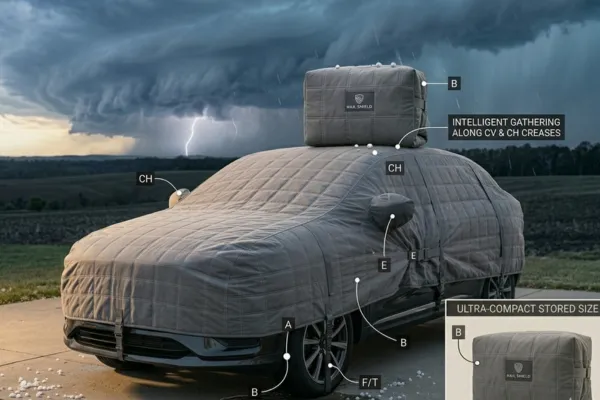
The Quilted Grid System — How Hail Shield's Core Technology Actually Works
Why Technology Matters in a Vehicle Cover
When most people think about a car cover, they don't think about technology. They think about fabric. They think about fit. They think about whether it'll blow off in the wind or take too long to put on.
Technology isn't the first word that comes to mind — and for most covers on the market, that's appropriate. Most covers are, fundamentally, sheets of material designed to keep dust and UV exposure off a vehicle. The engineering involved is minimal because the challenge being addressed is minimal.
Hail protection is a different challenge entirely. And solving it properly required genuine engineering — specifically, the quilted grid system that sits at the heart of Hail Shield's design. Understanding how that system works, and why it works, is the clearest way to understand what separates Hail Shield from every other product in the vehicle cover category.
The Physics of Hail Damage
To understand the quilted grid system, you first need to understand the physics of what hail actually does to a vehicle.
Hail damage is caused by concentrated impact. A hailstone — traveling at significant velocity, often in combination with strong winds — strikes a specific point on your vehicle's surface and delivers its kinetic energy to that point. The metal panel beneath that point flexes under the force and, if the force is sufficient, deforms permanently. That deformation is what we see as a dent.
The critical word in that description is "concentrated." The hailstone's energy arrives at one point. If that energy can be kept concentrated at one point, it causes a dent. If that energy can be spread outward — distributed across a larger area — the force delivered to any individual point on the vehicle's surface is reduced dramatically. Reduced far enough, it falls below the threshold required to cause permanent deformation.
This is the fundamental engineering principle behind the quilted grid system. Not absorption — distribution. The goal is not to absorb the hailstone's energy but to spread it across the largest possible surface area, reducing the per-point force to levels that don't cause damage.
How the Quilted Grid System Distributes Force
The quilted grid design creates a structured network of interconnected cells across the surface of Hail Shield. When a hailstone strikes any point on this surface, the grid structure channels the impact energy outward through the surrounding cells rather than allowing it to concentrate and transfer directly downward to the vehicle panel.
Think of it like this: imagine pressing your thumb hard onto a solid surface versus pressing it onto a grid of interconnected springs. In the first case, all the force from your thumb transfers directly to the surface at one point. In the second case, the springs distribute that force outward — the point directly under your thumb receives a fraction of the total force, with the remainder spread across the surrounding area.
The quilted grid functions on a similar principle. The structured grid pattern creates a force-distribution network that interrupts the direct transfer of impact energy from the hailstone's strike point to the vehicle surface beneath. The larger the grid network and the more robust the interconnections, the more effectively force is distributed — and the less concentrated force reaches any single point on your vehicle's panels.
Why Single-Layer Covers Don't Achieve This
Standard car covers, regardless of their thickness or material quality, cannot achieve meaningful impact distribution because they lack the structural grid system that makes distribution possible.
A single layer of material — even a thick, dense material — responds to a hailstone impact in essentially one way: it flexes at the point of impact and transfers force through to whatever is beneath it. The material's thickness may slow this transfer marginally and absorb a small amount of energy in the process. But without a structural system designed to channel force outward, the fundamental physics doesn't change. The energy still concentrates at the impact point. The panel beneath it still receives the concentrated force. The dent still happens.
This is why the common recommendation to "use a thick cover" for hail protection produces consistently disappointing results. Thickness without structure doesn't solve the distribution problem. It just adds a slightly thicker intermediary between the hailstone and the damage — one that may reduce the severity of a dent slightly but cannot prevent it.
The quilted grid system solves the problem that thickness alone cannot.
The Role of Military-Grade Materials
The quilted grid system doesn't work in isolation. Its effectiveness depends on the material properties of the cover it's built into — and this is where Hail Shield's military-grade outer shell becomes critical.
For the grid system to distribute force effectively, the material needs to maintain structural integrity under impact rather than simply compressing or tearing at the strike point. A grid built into flimsy material degrades rapidly under repeated impact — the grid structure collapses, the force distribution fails, and the cover becomes progressively less effective with each storm.
Military-grade materials provide the structural durability that keeps the quilted grid performing at full effectiveness through repeated deployments across multiple storm seasons. The outer shell is designed to take serious impact — not just pea-sized nuisance hail but the larger, higher-velocity stones that cause the most significant vehicle damage — without losing structural integrity.
This combination — an engineered grid system built into military-grade materials — is what makes Hail Shield's protection genuinely reliable rather than merely theoretical.
Practical Implications for Your Vehicle
What does all of this mean in practical terms for a driver deploying Hail Shield in a real storm?
It means that when a hailstone strikes the surface of your cover, the quilted grid system is actively working to spread that impact energy across the surrounding area. Your hood panel, your roof, your trunk lid — they're receiving distributed force rather than concentrated force. The threshold required to cause permanent deformation is not being reached at any individual point because the energy that would have concentrated at that point has been spread outward through the grid.
The result is a cover that doesn't just sit on your car. It actively manages the physics of hail impact in real time, during the storm, on every panel it covers.
For larger hailstones — the kind that cause the most significant and expensive damage — this active management is the difference between a protected vehicle and one that requires thousands of dollars in repairs. For smaller stones, it's the difference between minor surface damage and nothing at all.
The Innovation That Makes Hail Shield Credible
It would be easy to make broad claims about hail protection without the engineering to back them up. The market has plenty of products that do exactly that — generic covers with aggressive marketing language that doesn't survive contact with a real hailstorm.
The quilted grid system is what makes Hail Shield's claims credible. It's a specific, engineered solution to a specific, well-understood physical problem. It works because the physics of force distribution are real and reliable — not because of marketing language, not because of material thickness alone, but because the structural design of the cover actively interrupts the impact physics that cause hail damage.
This is the innovation that the inventor built from scratch because it didn't exist anywhere in the market. The engineering behind it is why Hail Shield works when other covers don't — and why drivers who understand the difference choose Hail Shield without hesitation.
Visit the official Hail Shield product page today. Visit Hail Shield now: https://haleshield.com/


