How to Build a Complete Hail Season Prep Plan — A Practical Guide for Drivers
Preparation Is the Only Strategy That Works
There's a certain type of driver who approaches storm season the same way every year. They watch the first hail warning of spring roll across their phone screen, feel a familiar wave of anxiety about the car in the open lot, and resolve — again — to do something about it before the next one.
Then the warning passes without incident. Life moves on. The resolution fades. And the cycle repeats until the season finally produces a storm that costs them thousands.
This guide is for breaking that cycle. Not with vague intentions but with a specific, practical, executable hail season prep plan that works in the real world — for real drivers who park outside, work in open lots, and live in regions where hail is a seasonal reality.
Step 1: Understand Your Personal Risk Profile
Effective preparation starts with honest assessment. Not every driver faces the same hail risk, and not every vehicle faces the same stakes. Understanding where you sit on both dimensions is the starting point for building a prep plan that's appropriately calibrated.
On the geographic side, ask yourself honestly where your vehicle spends most of its time. Do you live in a high-risk region — Texas, the Great Plains, the Midwest, the Southeast? Do you work in an open lot in an area with active storm seasons? Do you regularly drive through hail country on commutes or road trips?
On the vehicle side, consider what's actually at stake. A daily commuter that you plan to trade in next year carries different stakes than a collector car with original paint or a performance build that represents years of investment. The higher the value and irreplaceability of what you're protecting, the more seriously the prep plan deserves to be taken.
Your honest answers to these questions determine how aggressive your hail season prep should be — and Hail Shield belongs in every version of that plan regardless of where you fall on the risk spectrum.
Step 2: Get Hail Shield in Your Trunk Before Storm Season Starts
This is the most important single step in any hail season prep plan, and the timing matters.
The single most common mistake drivers make with hail protection is reactive purchasing — ordering or acquiring protection after the first storm of the season has already hit. By then, the preparation opportunity has passed. The damage has been done. The cover is on the way but wasn't there when it mattered.
Getting Hail Shield in your trunk before storm season starts means you're covered from the first warning of the year. It means that the first storm of the season — which often arrives before drivers have fully shifted into storm-season awareness — finds you prepared rather than caught off guard.
In high-risk regions, storm season begins in earnest around March and April. In the most active hail months of May and June, storm frequency and severity peak. Getting Hail Shield in place by late February or early March means you're ready from the season's first serious event rather than scrambling after it.
Step 3: Set Up a Reliable Weather Alert System
Hail Shield gives you the tool to act when a storm warning hits. A reliable weather alert system gives you the advance notice to act in time.
Most smartphones have default weather apps that provide general forecasts — but general forecasts aren't what you need for hail preparation. You need push notifications for severe weather warnings in your current location, updated frequently enough to catch rapidly developing storm systems.
Several weather apps provide granular, real-time severe weather alerts specifically designed for the narrow warning window that hail events create. Setting up these alerts — and making sure they're enabled and audible, not silent — is a critical component of your hail prep plan. Hail Shield in your trunk is only half the equation. Knowing the storm is coming with enough time to deploy it is the other half.
Step 4: Develop a Parking Awareness Habit
This step doesn't require technology or purchases. It requires a small, consistent shift in how you think about where you park.
Developing parking awareness during storm season means making covered parking a priority when it's available and a reasonable option — not because you'll always find it, but because the habit of looking for it slightly increases the proportion of time your vehicle spends under cover during the highest-risk months.
It also means noting your open lot exposure situations — the work parking lot, the shopping center, the regular stops where your vehicle sits outside for extended periods — and treating those situations with appropriate awareness during storm season. Not anxiety. Just awareness — the kind that means you're already thinking about Hail Shield when the warning notification arrives rather than scrambling to remember where you put it.
Step 5: Practice Your Deployment
This step sounds unnecessary until the first time you're in a parking lot with eight minutes on the clock and you've never actually deployed Hail Shield before.
Hail Shield is designed for fast, intuitive deployment. The process is straightforward. But doing it once in calm conditions in your driveway — before the first real storm of the season — means the first time you do it under actual storm pressure isn't also the first time you do it at all.
A single practice deployment takes five minutes. It familiarizes you with how the cover unfolds, how the buckle and strap system works, and what the fully deployed cover should look like on your specific vehicle. It eliminates the fumbling and uncertainty that can slow deployment in a real emergency. And it means that when the warning hits at the office parking lot on a Tuesday afternoon in May, you execute confidently and quickly because you've done it before.
Step 6: Make It a Seasonal Routine
The most effective hail prep plan is one that runs automatically — one that you don't have to remember to execute each year because it's built into your seasonal routine.
This means putting Hail Shield in your trunk at the start of every storm season as a fixed habit — the same way you put winter gear in your vehicle before the first frost or check your tire pressure at seasonal changes. It means keeping it there through the full active storm season rather than moving it in and out based on specific forecasts. And it means doing a quick check at the start of each season to make sure the cover is in good condition and the storage bag is intact.
A seasonal routine removes the decision-making burden from the equation. You don't have to remember to be prepared. You're already prepared because preparation is part of how you operate between March and September every year.
The Complete Hail Season Prep Plan
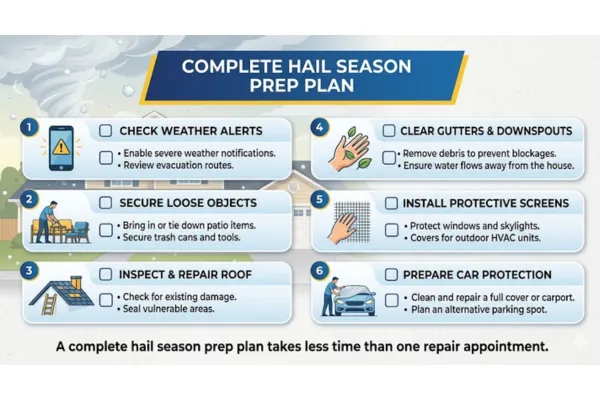
Put together, your complete hail season prep plan looks like this:
✅ Assess your risk — geography, exposure situations, vehicle stakes
✅ Get Hail Shield in your trunk before storm season begins
✅ Set up real-time severe weather alerts on your phone
✅ Develop parking awareness during storm season months
✅ Practice one deployment in calm conditions before the first storm
✅ Make it a seasonal routine — in the trunk from March through September, every year
This plan works in high-risk regions and low-risk ones. It works for daily commuters and collector vehicles. It works for motorcycle riders and truck owners and everyone in between. It's practical, executable, and it addresses the outdoor parking problem in every scenario — not just the ones where conditions cooperate.
Storm season rewards the prepared. This is how you become one of them.
Visit the official Hail Shield product page today. Visit Hail Shield now: https://haleshield.com/


