Why Parking Outside Is a Gamble Every Storm Season — And How to Stop Losing
The Risk Most Drivers Accept Without Realizing It
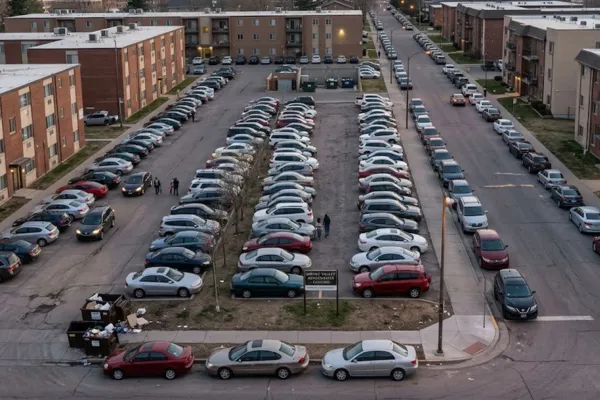
Every morning, millions of drivers pull out of their driveways, park in open lots, leave their vehicles on city streets, and head inside — without giving a second thought to what the afternoon sky might bring. It's routine. It's unavoidable for most people. And for most of storm season, nothing happens.
But routine doesn't mean safe. And "nothing happened today" is not the same as "nothing will happen." Every day a vehicle sits unprotected in an open lot during storm season is a day that driver is accepting risk they may not have consciously chosen — risk that has a real dollar value attached to it and a real probability of materializing.
Parking outside during storm season is a gamble. Most drivers take that gamble every single day without fully understanding the odds — or the stakes. And the frustrating part is that most of them would choose differently if they had a practical option. Until Hail Shield, they largely didn't.
The Odds Are Worse Than Most Drivers Think
When people assess personal hail risk, they tend to underestimate it in the same way people underestimate most low-frequency, high-cost events. It hasn't happened yet. It probably won't happen today. The sky looks fine right now.
This thinking is understandable. It's also how drivers end up walking out to dented cars year after year.
The statistical reality of hail risk in the United States is significant. Hailstorms cause billions of dollars in vehicle damage annually. In high-risk regions, multiple damaging hail events per season are common rather than exceptional. Insurance industry data consistently shows vehicle hail claims as one of the highest-volume weather-related claim categories year after year.
More practically — if you park outside in a hail-prone region, work in an open lot five days a week, and storm season runs five to six months per year, the cumulative probability of experiencing at least one significant hail event during that exposure window across several years approaches certainty rather than possibility.
The question isn't really "will it happen?" The question is "when will it happen, and will I be ready?"
What the Typical Unprotected Hail Event Actually Costs
Part of what makes the outdoor parking gamble so costly is that most drivers don't fully understand what they're betting until after they've lost.
The repair bill is the most visible cost — and it's significant. Average hail damage repairs run $2,500 to over $10,000 depending on severity. But as we've covered elsewhere, the repair bill is only the beginning. The deductible comes out of pocket first. The body shop waitlist stretches weeks. The insurance premium increases afterward. The vehicle's resale value carries a permanent depreciation from documented damage history.
A single unprotected hail event doesn't just cost money in the moment. It costs money for years — in premiums, in depreciation, in the ongoing awareness that your vehicle's history now includes a weather damage record that follows it to every future owner.
The total cost of a single moderate hail event, fully accounted for across all downstream impacts, can realistically reach $5,000 to $15,000 or more. That's the bet every driver places when they park outside unprotected during storm season. Most of them have no idea the stakes are that high.
Why "Finding Covered Parking" Isn't a Real Strategy
The most common advice for drivers worried about hail is also the least practical: find covered parking when storms are forecast.
This advice assumes several things that are often not true. It assumes covered parking is available near where you need to be. It assumes you have enough advance warning to act on the forecast before storms develop. It assumes you can leave whatever you're doing — work, appointments, obligations — to move your vehicle when the forecast changes.
None of these assumptions hold reliably in the real world. Covered parking in urban and suburban areas is a premium resource that's frequently full, inconveniently located, or simply nonexistent near where many people work and shop. Storm forecasts, particularly in hail-prone regions, often underestimate intensity and speed of development — giving drivers less warning than they expected. And leaving work or interrupting a commitment to move a car is not always possible, regardless of what the sky is doing.
"Find covered parking" is advice that works in theory and fails in practice for the majority of drivers in the majority of real hail scenarios. It sounds like a solution while leaving the underlying problem completely unaddressed.
The Only Strategy That Actually Works
The strategy that works — the one that addresses the outdoor parking problem in every scenario, not just the ones where conditions cooperate — is having Hail Shield in your trunk.
Not at home. Not in the garage. In the trunk of your vehicle, all season, every day you park outside.
This is the design philosophy that makes Hail Shield fundamentally different from every other approach to hail protection. It doesn't require covered parking to be available. It doesn't require perfect forecast accuracy. It doesn't require you to leave what you're doing and move your vehicle before the storm arrives. It requires you to walk to your car, pull out a compact bag, unfold a cover, and secure it — in minutes — when the warning hits.
That's a realistic, executable response to a storm warning in an open parking lot. Everything else involves hoping conditions cooperate. Hail Shield is the option that works regardless of whether they do.
What Makes Hail Shield the Right Tool for This Problem
Every feature in Hail Shield exists specifically to address the outdoor parking problem in real-world conditions.
The compact storage bag solves the availability problem. A cover that doesn't travel with you can't protect you when you're away from home. Hail Shield's storage bag is designed to fit comfortably in your trunk permanently — not occasionally, not when you remember to bring it, but all the time, as a standard part of your vehicle's equipment.
The rapid deployment design solves the time problem. When you have eight minutes between a storm warning and the first hailstone, you need a cover that goes on fast. Every element of Hail Shield's deployment process was engineered with that time pressure in mind.
The quilted grid system solves the impact problem. A cover that sits between the hailstone and your vehicle but doesn't interrupt the force transfer is better than nothing and worse than real protection. The quilted grid distributes impact force across the cover's surface, genuinely reducing the concentrated energy that reaches your vehicle's panels.
Military-grade materials solve the durability problem. A cover that handles a few light storms before degrading isn't a serious protective solution. Hail Shield is built to perform in serious storm conditions, repeatedly, across multiple seasons.
The buckle and strap securing system solves the wind problem. Storms don't arrive in calm conditions. The securing system keeps Hail Shield in place when wind is actively working against it — maintaining consistent coverage across the vehicle's entire surface.
Changing Your Relationship With Storm Season
Here's what shifts when Hail Shield becomes part of your vehicle's standard equipment.
Storm warnings stop being sources of helpless anxiety and start being actionable events. Instead of watching the weather develop from inside with nothing to do, you have a clear, fast, effective response. You go to the car, you deploy the cover, you go back inside. The storm is someone else's problem.
That shift — from helpless to prepared — has a value that goes beyond the financial. Storm season in hail country is genuinely stressful for drivers who park outside. The persistent background awareness that any given day could be the day that costs thousands of dollars is a real mental burden. Hail Shield removes that burden. It replaces anxiety with confidence — the confidence of knowing that when the warning hits, you have an answer.
Stop Taking the Gamble
Every storm season, millions of drivers bet their vehicles against the weather — and lose. Not because they're careless. Not because they don't care about their vehicles. But because until now, the practical alternative to the outdoor parking gamble simply didn't exist in a form that worked in the real world.
That alternative exists now. It fits in your trunk. It deploys in minutes. It's built to military-grade standards and engineered specifically for the hail impact problem that standard covers never solved.
Stop taking the gamble. Put Hail Shield in your trunk before the next warning hits.
Visit the official Hail Shield product page today. Visit Hail Shield now: https://haleshield.com/


