5 Situations Every Driver Should Have Hail Shield Ready For
Protection That Goes Where You Go
The most important thing about Hail Shield isn't just what it does. It's where it does it.
Most vehicle protection solutions are fixed. A garage protects the car when it's at home. A carport does the same. Even a standard car cover, realistically, ends up protecting the vehicle in the driveway — because that's where the cover is stored, and that's where it gets used.
Hail Shield is different because it's designed to be mobile. It lives in your trunk. It goes wherever your vehicle goes. And that means it can protect your vehicle not just at home, but everywhere — in every parking lot, at every destination, in every situation where the weather turns and you need to act fast.
That mobility is what transforms Hail Shield from a useful product into an essential one. Because hail doesn't restrict itself to your driveway. It finds your car wherever your car happens to be. And the scenarios below are where it's most likely to find you unprepared — unless Hail Shield is already in your trunk.
Situation 1: The Office Parking Lot
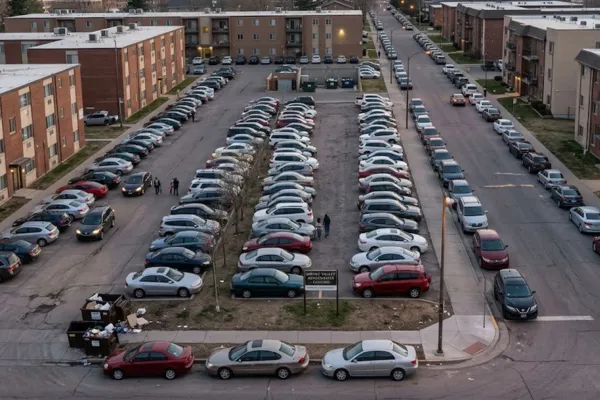
This is the most common scenario for hail damage — and the one where drivers feel most helpless.
You're at work. Your car is in the parking lot. The storm develops over the course of the morning, or arrives suddenly at noon, or builds all afternoon while you're in back-to-back meetings with no ability to step outside. By the time the warning hits your phone, the storm is already on top of you.
You can't move the car. There's no covered parking nearby, or what exists is full. You have minutes — if that — before the hail starts. Without Hail Shield, there is literally nothing you can do.
With Hail Shield in your trunk, the scenario changes completely. You see the warning. You walk to the parking lot. You deploy the cover in minutes. You walk back inside. The storm arrives, does its work on every unprotected vehicle around yours, and passes. You walk out to an undamaged car.
That's the entire difference. One cover in your trunk converts the most helpless hail scenario most drivers face into a fully manageable one.
Situation 2: The Car Show or Outdoor Event
You drove something special to get here. A classic. A performance build. A collector piece that represents years of work and genuine passion. You parked it carefully. You detailed it the day before. And now, three hours into the show, the sky is turning green and the event organizers are asking everyone to stay calm.
Show parking is almost never covered. Events don't come with weather guarantees. And a storm that rolls through an outdoor car show can damage dozens of carefully maintained vehicles in minutes — vehicles that represent significant financial and emotional investment by their owners.
Hail Shield stores compactly enough to travel to every show in your trunk or your trailer. It deploys fast enough to cover your vehicle before the hail arrives — even in the compressed timeframe of a show parking scenario where moving vehicles isn't practical. And it provides the military-grade impact protection that irreplaceable paint and bodywork genuinely deserve.
The collector who brings Hail Shield to every show isn't being overly cautious. They're being appropriately prepared for the reality of outdoor event parking in a country where hail season and car show season overlap almost entirely.
Situation 3: The Road Trip Through Hail Country
You're driving through Texas in June. Through Kansas in May. Through Oklahoma in late spring. You're passing through some of the most hail-active geography in the United States during some of the most storm-active months of the year.
You stop for the night at a hotel. Open parking lot. No garage option. The forecast looked manageable when you checked it — but forecasts in storm country have a way of changing quickly, and a storm that develops overnight isn't something you'll catch with adequate warning.
Without Hail Shield, you're taking a genuine gamble every overnight stop through hail country. With it, you cover the car before you check in — a five-minute process — and sleep without wondering what you'll find in the morning.
Road trips through hail country are some of the highest-risk situations any driver faces, precisely because you're away from your home routines, in unfamiliar territory, with less control over parking situations than you'd normally have. Hail Shield closes that vulnerability gap completely.
Situation 4: Street Parking in Storm Season
City living means street parking for millions of drivers — and street parking means fully exposed, every night, every week, through an entire storm season.
There's no garage to pull into when the forecast turns threatening. There's no carport providing partial coverage. There's just the street, your car, and whatever the night brings.
This is one of the highest cumulative exposure situations any driver faces — not because any individual storm is more severe, but because the exposure is continuous and the ability to respond is limited. A storm at 3 AM doesn't wake most people with enough time to get outside and cover a street-parked vehicle before the hail arrives.
The solution is proactive rather than reactive. During hail season, street parkers who use Hail Shield develop a simple habit — check the evening forecast, and if storm potential exists overnight, deploy the cover before going inside for the night. The process takes minutes. The protection it provides lasts through whatever the night delivers.
Situation 5: The Unexpected Storm at the Worst Possible Time
You checked the forecast this morning. Clear skies. Low storm probability. You parked in the open lot at the shopping center, went inside, and didn't think twice about the weather.
An hour later, the sky has gone from blue to green and your phone is buzzing with a severe weather alert you did not see coming.
This is the scenario that catches the most drivers off guard — not because they're careless, but because weather in hail country can develop faster than forecasts predict. A system that looked benign at 9 AM can produce serious hail by 11. And when that happens in an open lot where you parked without weather on your mind, the result is entirely determined by whether Hail Shield happened to be in your trunk.
If it is, you have a chance. You act on the warning, deploy the cover, and get back inside before the storm arrives. If it isn't, you don't.
This is the scenario that most clearly illustrates why "always in your trunk" is the only deployment philosophy that actually works. Hail doesn't schedule itself around your preparedness. It finds you wherever you are, whenever it wants. The only consistent defense is consistent availability — and the only way to guarantee consistent availability is to keep Hail Shield in your trunk, all season, every season.
The Common Thread Across All Five
Every scenario above has exactly one thing in common: the storm didn't care about the driver's plans, their parking situation, their insurance coverage, or their repair budget. The only variable that changed the outcome was whether Hail Shield was within reach when the warning hit.
That's what trunk storage actually means. Not convenience. Not a nice feature. Control — in situations where drivers have historically had none.
One cover. In your trunk. All season. That's the entire strategy. And it works in parking lots, at car shows, on road trips, on city streets, and in every unexpected storm that finds your vehicle somewhere other than your garage.
Storm season doesn't wait. Make sure Hail Shield doesn't have to either.
Visit the official Hail Shield product page today. Visit Hail Shield now: https://haleshield.com/


